Doña Rosa
Rosa Real Mateo de Nieto was a ceramics artisan from Oaxaca, Mexico. Doña Rosa is renowned for her method of making barro negro. The black, shiny appearance is fully realized after firing the clay. Explore here to learn more about Doña Rosa, and the store, workshop & studio in San Bartolo, Coyotepec.
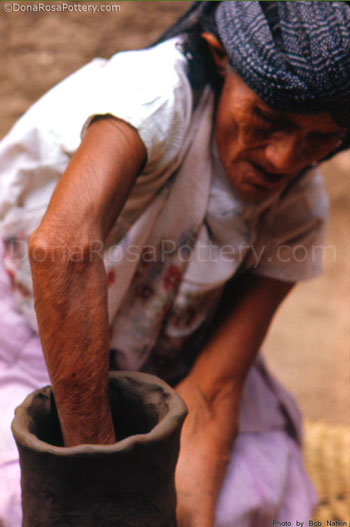
Doña Rosa forming clay for barro negro pottery.
Doña Rosa’s ceramics
Doña Rosa’s black pottery became a favorite of collectors and is now mimicked by others throughout Oaxaca and elsewhere. Barro negro pottery has been produced for hundreds of years.
Examples of it have been found at numerous archeological sites in Mexico. This style of black clay pottery has remained a traditional craft of the indigenous Zapotec and Mixtec peoples to this day. The well-known archaeologist, Alfonso Caso, and other friends would visit Doña Rosa and her family at the family home and workshop and watch her create works of barro negro. Caso was devoted to the studying of contemporary Indigenous peoples and pre-Hispanic cultures. The family was visited by many artisans, artists, and collectors, including Nelson Rockefeller, who introduced her work to many in the United States.
Doña Rosa became a famous master of this form of Mexican folk art. She practiced her craft for decades, producing the often shiny, black clay pottery without glaze and without paint using techniques she developed and sold the works from her family home and studio.
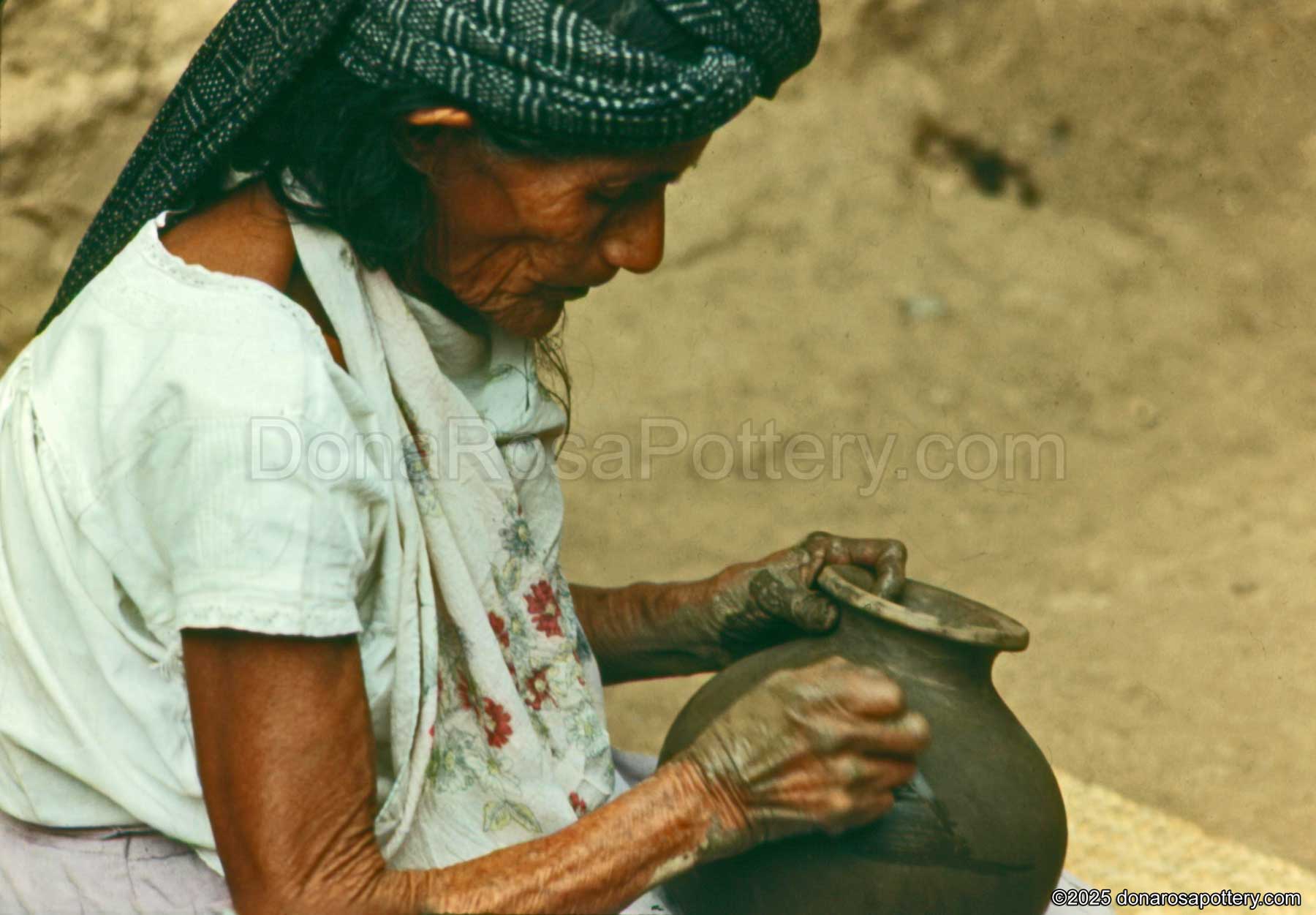
Doña Rosa using a stone to apply finish before firing clay.
Early examples of barro negro had a matte finish. Doña Rosa discovered in the 1950s that she could change the color and shine of her ceramics using a technique still employed. She would polish it with a quartz stone before firing, when the clay is nearly completely dry. While more shinny than traditional barro negro, this technique produces ceramics that are more brittle and breakable. Historically, matte finished barro negro was more durable. It was traditionally used to make large, tall vessels, known as cántaros, used for carrying and storing water and mezcal. In the early years, Doña Rosa produced and used this type of barro negro cántaros in everyday life, including perforated pots used for draining nixtamal (corn for grinding).
Stone polishing compresses the surface of the clay before it is drying is complete. Then by firing at slightly lower temperature than normal, the result is a much more shinny surface. This tends to produce a more brittle pottery, so it is more ornamental than functional. She produced a wide variety of vessels and figures.
The photo above shows Doña Rosa polishing a pot after the clay has dried. The vessel will then be ready for firing and the black color will emerge. The photos of Doña Rosa on this page were taken in the mid-1960’s.
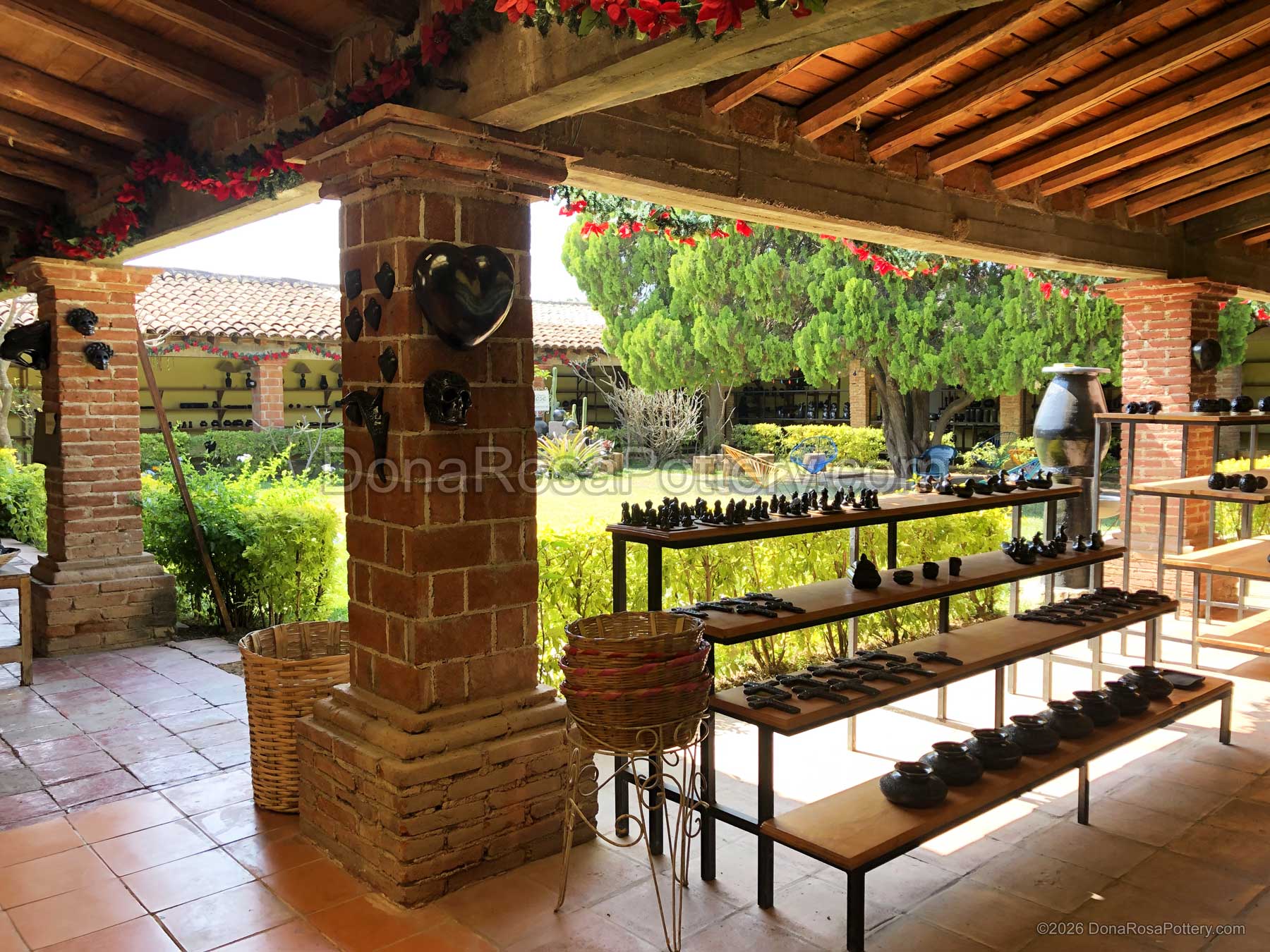
Area surrounding courtyard. and barro negro on display, at Doña Rosa workshop studio in San Bartolo, Coyotepec.
Doña Rosa died in 1980 but barro negro is still sold from the family home, where her daughter and grandchildren carry on the tradition. The studio and store are open to the public and workshops and demonstrations are offered.
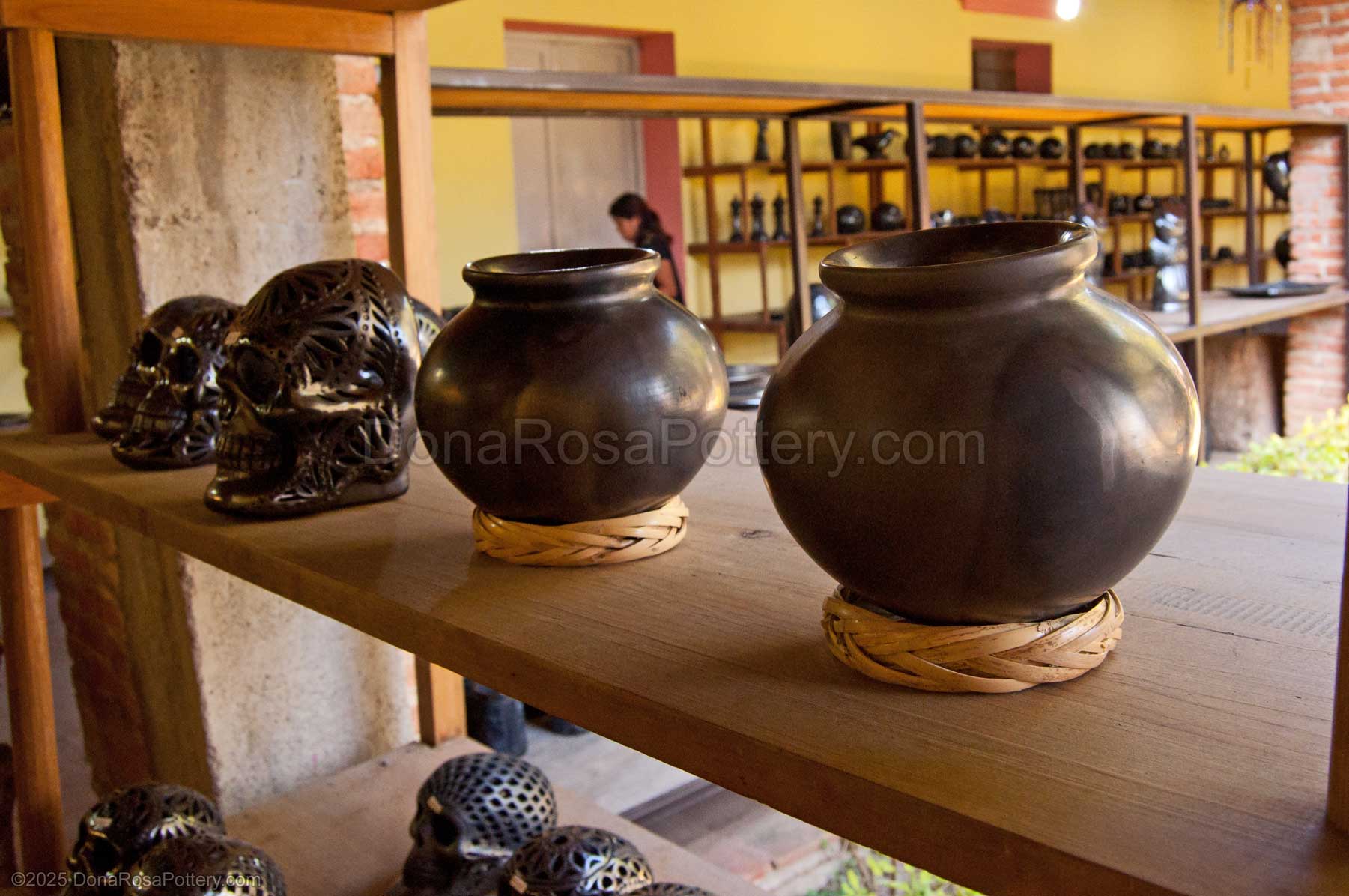
Barro negro